


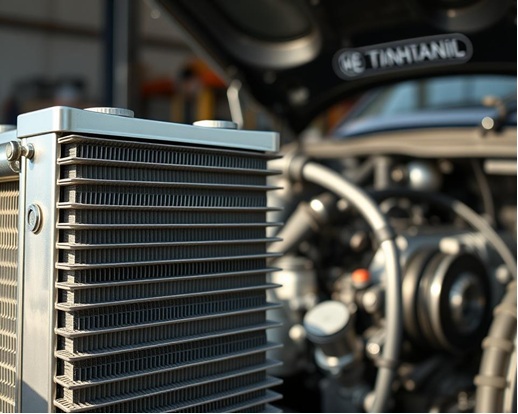
Engine oil does more than just cut friction. It also helps control oil temperature by carrying heat away from parts. This makes it a secondary cooling system, working with the radiator, fans, and airflow.
An engine oil cooler is a special heat exchanger. It helps shed extra heat from the oil. Hot oil goes through small passages, losing heat to air before returning to protect engine parts.
This cooling system is important. Oil needs to stay at a certain temperature to work right. If it gets too hot, it can thin out and lose its protective film. This hurts the engine.
On the other hand, if it’s too cool, moisture and fuel vapors can build up. This makes the oil dirty faster.
In simple terms, a car oil cooler keeps oil from getting too hot during long drives or towing. Many kits have a thermostat. This lets the oil warm up first and then cool down when needed.
Oil cooler basics are easy to understand. Just think of a loop: heat goes from metal to oil, then from oil to air, and then back again every time you drive.
Key Takeaways
- A car oil cooler is an oil heat exchanger that lowers oil temperature by shedding heat to airflow.
- Engine oil supports engine longevity by lubricating parts and acting as a secondary cooling system.
- An oil cooling system circulates oil out of the engine, through the cooler, then back at a lower temperature.
- Good oil temperature control helps prevent thinning oil and reduces protection under heavy use.
- Keeping oil in a safe band also helps limit moisture buildup and contamination.
- A thermostatic engine oil cooler can reduce the risk of oil running too cool in mild or cold conditions.
What an Oil Cooler Does for Engine Protection and Performance
Engine oil does more than just prevent parts from rubbing together. It also helps move heat away from important engine parts. This is true when the engine is working hard.
Heat is key because it keeps the oil thick. A thick oil film is essential to keep metal parts apart. But, if the oil gets too hot, it can lose its thickness. This makes it harder for the engine to move smoothly.
Cold starts are also a problem. When it’s cold, oil moves slowly. This means parts can rub together more, causing wear and tear. It takes a while for the engine to warm up and run smoothly.
An oil cooler helps cool the engine even more. It does this by moving oil through a special heat exchanger. This way, the engine doesn’t have to work as hard to stay cool. It’s good for long drives and city traffic.
Keeping the engine cool also helps keep it clean. The engine makes byproducts that can leave moisture. If the oil gets hot enough, this moisture can boil off. This prevents sludge from building up.
| Oil Temperature State | What Happens in the Engine | Impact on Protection and Performance |
| Too cold (short trips, cold mornings) | Slow flow and higher drag; moisture can linger in the sump | Protective oil film may form unevenly; engine wear prevention is harder during warm-up |
| In range (steady cruising) | Stable circulation supports engine oil lubrication and consistent oil heat transfer | Strong oil viscosity barrier supports internal wear reduction with smooth response |
| Too hot (towing, track days, high ambient heat) | Oil thins and sheds heat less effectively without added capacity | Protective oil film can weaken; secondary cooling from an oil cooler helps hold a safer margin |
Car Oil Cooler Basics and Core Components
An oil cooler is a device that cools engine oil. It does this by removing extra heat picked up by the oil. Most oil coolers are mounted in a way that outside air can carry away the heat.
Inside, oil flows in one side and out the other. The core has finned tubes that increase its surface area. This lets air strip heat from the oil as it moves through.
More surface area and clean airflow mean faster heat transfer. This is similar to how a coolant radiator works. But, if airflow is blocked, the cooler can’t cool the oil effectively.
The hardware supporting the cooler is just as important. Oil cooler lines must handle heat and pressure. They should be routed away from harmful areas. Quality fittings prevent leaks and keep the system stable, even when the oil is cold and thick.
| Component | What it does | What to check |
| Radiator-style oil cooler core | Sheds heat to outside air through fins and tubes | Size matched to power and use; not bent or blocked |
| Finned tubes | Carry oil while fins boost surface area for cooling | No crushing; fins kept clear of mud and bugs |
| Oil cooler lines | Move oil to and from the cooler | Proper length, abrasion protection, safe routing |
| Oil cooler fittings | Seal connections at the cooler, sandwich plate, or adapter | Correct thread and angle; no weeps after heat cycles |
| Mounting airflow path | Ensures steady air passes across the core at speed | Direct air path; secure brackets; room for fan flow if used |
Adding a cooler increases the system’s oil capacity. The core and lines hold more oil than before. This means the pump has to work harder to move oil through longer passages. A cooler that’s too small can actually slow things down.
How a Car Oil Cooler Works in Real Driving Conditions
In everyday driving, a car’s oil cooler works in a simple way. Hot oil leaves the engine, loses heat, and then goes back to the engine. This cycle happens over and over again, even when the car is under heavy load.
On the highway, the cooler works best because more air flows over the fins. Even in city driving, the cooler keeps the oil cool, even when stopped at lights. If the car has a fan, it helps keep the oil cool at low speeds, too.
When driving hard, in hot weather, or towing, a good cooler can drop oil temperature by 30-50°F. This keeps the oil at a safer temperature. The cooler’s performance depends on its location, size, and how clean the fins are.
Warm-up is critical. The oil cooler thermostat and thermostatic bypass control the flow. This prevents the oil from getting too cold on chilly mornings. The bypass lets most oil bypass the cooler until it gets hot enough.
This strategy avoids overcooling, which can lead to moisture and fuel vapors in the oil. It also helps the oil get hot enough to boil off water. This keeps the oil clean. The bypass stops the oil from getting too cold when it’s not needed.
| Driving condition | What happens to the oil flow path | What changes airflow cooling efficiency | What the oil cooler thermostat and thermostatic bypass do | Typical temperature outcome |
| Cold start in mild weather | Oil circulates fast; cooler circuit is limited early | Low at first because vehicle speed is near zero | Bypass prioritizes warm-up and reduces overcooling risk | Oil climbs toward water-boil threshold faster |
| Stop-and-go commute | Continuous loop; heat spikes with repeated acceleration | Moderate; cooler stiil radiates heat at idle | Valve trims flow through the core as temps rise | Stop-and-go oil cooling steadies temps vs. no cooler |
| Highway cruising | Stable circulation through the cooler core | High due to steady airflow across fins | Mostly open to the cooler once at operating temp | Lower, more consistent oil temps over long runs |
| Towing or long grades | Maximum heat load; higher flow and higher oil pressure | High if mounted in clean, direct airflow | Bypass closes progressively, forcing more oil through cooling circuit | Possible 30-50°F oil temp drop when sized well |
Oil Temperature, Viscosity, and the “Safe Range” for Street vs. Hard Use
Oil does two jobs: it lubricates and carries heat. The engine oil temperature range affects how well it protects parts.
Oil viscosity changes with temperature. It’s thick when cold and thinner when hot. This means your engine can feel tight in the cold and looser when it warms up.
Multi-grade oils help with this change. For example, 5W-30 oil is good for cold starts and warm driving. It keeps your engine running smoothly.
For daily driving, an oil temperature of 180-215°F is normal. Most engines run best at 200-215°F. This keeps the oil film thick enough to protect the engine.
Moisture can be a problem if oil doesn’t get hot enough. If it rarely hits 212°F, water and fuel vapors can cause sludge and acid.
Cold oil can also be a problem. It moves slower and can wear out bearings and walls. It’s best to warm up the engine before driving.
Short trips can lead to oil changes more often. This is because the oil doesn’t get hot enough. Over time, this can be as damaging as long drives.
| Use case | Typical oil temp behavior | What it means for viscosity and wear | Practical watch-outs |
| Street commuting | Often settles near 180-215°F oil temp once fully warmed | Stable film thickness for daily loads; good balance for oil viscosity vs temperature | If it rarely reaches moisture burn-off 212°F, contaminants can build during repeated short trips |
| Spirited back-road driving | Frequently climbs toward the 200-215°F sweet spot | Good cleaning and steady pressure when oil grade matches the engine | Watch for heat soak after repeated pulls, specially in warm weather |
| Hard use (track days, towing, long climbs) | Can push beyond the usual engine oil temperature range for long periods | Thinner oil at higher temps can reduce the protective barrier if the system is overwhelmed | Oil breakdown 275°F becomes a concern with many conventional oils; full synthetic margins can extend toward synthetic oil 300°F |
High heat is risky. Conventional oil is okay up to 250°F. But, oil can break down at 275°F, leading to oxidation and deposits.
Full synthetics handle heat better. They can go up to 300°F without breaking down. This is why they’re good for high-heat driving.
When an Oil Cooler Helps Most and Key Considerations Before Adding One
Wondering if you need a car oil cooler? Think about how you drive. Track days can make oil temperatures soar, thanks to high speeds and heat. This can make oil too thin, harming your engine.
Street cars usually don’t need extra cooling. But, if you drive hard and then slow down, watch for oil pressure drops. This could mean your oil got too hot.
Before buying parts, check your engine’s health. Use gauges to see if it gets too hot. A thermostatic valve is key for street and track driving. It keeps the engine warm and prevents overheating.
Ready to install an oil cooler? Focus on airflow and protection from damage. Make sure lines are smooth and secure. Also, check oil levels and use strong brackets to avoid damage.
