


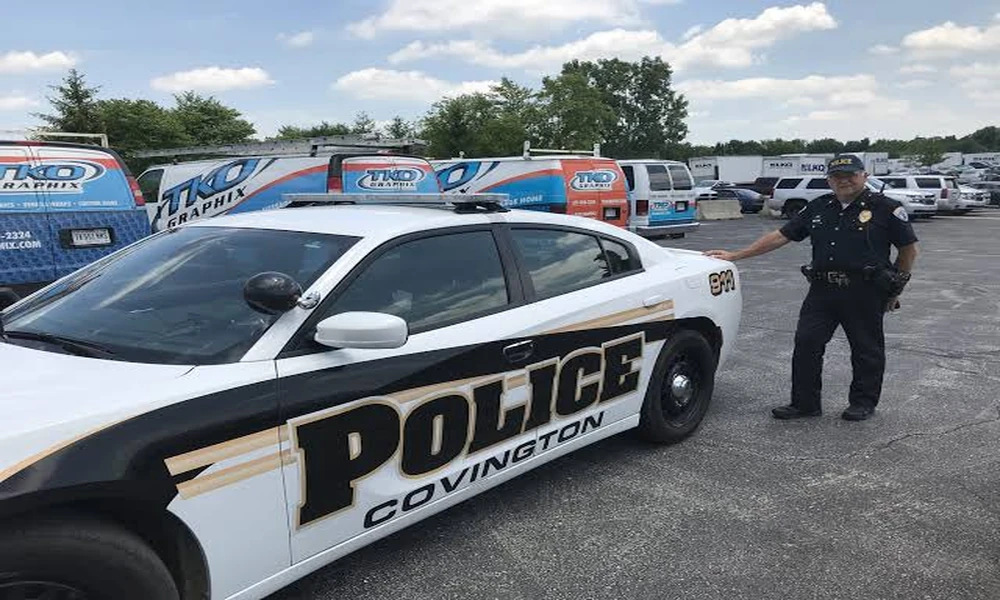
Next time you see a police car, take note of the design on the vehicle’s exterior. What color are the graphics? Are there badges or other images, or just words? Is the design applied to the entire vehicle or only to certain panels? You might be surprised how much thought goes into what looks, at a glance, like a straightforward paint job.
Most of what you’re looking at isn’t paint at all. Instead, it’s a vinyl wrap or a combination of wraps and individual decals. And behind every patrol car graphic is a set of decisions that departments, fleet managers, and graphics contractors navigate together.
9 Common Questions About Police Car Decals and Wraps
Once you start noticing these things, you might realize you have all kinds of questions about how police vehicle graphics work. Below, we’ve answered nine of the most common.
What exactly is a vehicle wrap, and how is it different from a decal?
Wraps and decals are similar in principle, but there are important differences.
A wrap is a large sheet of printed or colored vinyl. Vehicle wraps, as their name suggests, are applied directly to a vehicle’s surface. Wraps can cover a single panel, a half of a vehicle, or the entire exterior. The vinyl is engineered to conform to curves, door handles, mirrors, and body contours without wrinkling or lifting.
A decal is a smaller, pre-cut graphic that goes on top of either the vehicle’s base color or a wrap. For police vehicles, a badge, a star, a unit number, or a department name are common decal options.
You’ll often see police vehicles use both wraps and decals. A department might, for example, apply a white or black base wrap to the entire police car, then add individual decals for the badge graphic, jurisdiction name, and unit number on top.
What type of police vehicle can be wrapped?
Almost any vehicle with a smooth painted surface can be wrapped. Police departments wrap sedans, SUVs, pickup trucks, vans, motorcycles, and specialty vehicles, such as mobile command units and prisoner transport vehicles. If it has a body panel, it can almost certainly be wrapped.
The main limitation is surface condition. Wraps adhere best to paint that is clean, intact, and free of rust, significant scratches, or peeling clear coat. A vehicle with heavy surface damage will need bodywork before a wrap is applied. Otherwise, the vinyl conforms to every imperfection and the finished result looks unprofessional, and the adhesive bond suffers.
Newer vehicles with factory paint are ideal candidates. Older fleet vehicles in good shape work well too. The coachbuilder or graphics contractor will inspect the surface before installation and flag any necessary prep work.
Will a wrap damage the vehicle’s existing paint?
The short answer: a wrap applied and removed correctly protects more than it harms.
When properly installed and removed by a trained professional, a quality vinyl wrap does not damage factory paint. In fact, wraps often protect the underlying paint from UV exposure, minor abrasions, and environmental wear. Many fleet managers remove a wrap at the end of a vehicle’s service life and find the paint underneath in better condition than the exposed exterior.
Assessing the vehicle’s surface condition before installation is vital because paint that’s already compromised can sometimes lift when a wrap is removed. So, if your vehicles have a thin clear coat, previous repairs with non-OEM paint, or older factory finishes that have begun to degrade, address this first.
Removal technique is critical to consider here, too, because wrap removal requires heat and patience-it’s not a quick job and shouldn’t be undertaken by someone who hasn’t done it before.
A professional slowly peels the vinyl, using a heat gun to soften the adhesive, then uses a mild adhesive remover to clean any residue.
If you try to rip a wrap off cold, or leave it on far past the vinyl’s rated service life, you substantially raise the risk of damaging the paint.
Can additional decals be applied over a wrap?
Yes, and this is standard practice in law enforcement fleet graphics. A base wrap establishes the overall look (the color field, the chevron or stripe pattern, the background for graphics), and then individual decals go on top for elements that need precision, replacement, or post-application.
Let’s say a vehicle is reassigned to a different division or its unit number changes. With decals that have been applied over a wrap, a shop can remove and replace only the affected decal without touching the base wrap. This tends to be cheaper and less time-intensive than redoing the full graphic installation.
Are there different sizes for police vehicle wraps?
Yes. For police vehicles, wraps tend to be divided into a few categories based on coverage area, and most graphics contractors use some version of this framework:
- Full wrap: The vinyl covers the entire exterior of the vehicle: roof, hood, doors, quarter panels, bumpers, and mirrors. Full wraps give departments maximum design flexibility and the most uniform appearance across a fleet. They’re also the most labor-intensive to install.
- Three-quarter wrap: Coverage extends across most of the vehicle, but leaves certain areas (typically the roof and, sometimes, the hood) in the base vehicle color. Departments often choose this option when they spec vehicles in white or black from the factory, and the unwrapped sections match the design intent.
- Half wrap: The graphics cover roughly the lower or upper half of the vehicle. A common configuration for law enforcement is a wrap that runs along the lower body panels and doors, with the upper half of the vehicle remaining the factory color. This approach works well for departments with a two-tone color scheme built into their livery standards.
- Spot graphics or partial wrap: Individual panels or specific areas receive vinyl treatment. Often, this is a hood graphic, a door badge panel, or a rear quarter chevron. Spot graphics are often used on undercover or plainclothes vehicles where full markings aren’t appropriate, but some identifying element is still required.
What’s right for one department will depend on factors like its design standards, budget, and the vehicle’s existing color. A good graphics contractor will walk you through the tradeoffs for each option against your specific fleet.
How long does a police vehicle wrap last?
Under normal conditions, a high-quality vinyl wrap on a law enforcement vehicle lasts 3 to 5 years. Fleet vehicles accumulate mileage and exposure faster than personal vehicles, and patrol cars in particular are subject to regular washing, road debris, sun exposure, and the occasional hard contact with curbs, brush, or other vehicles.
If a department is in a climate with extreme heat and intense UV (like Arizona or Florida), they might see shorter wrap lifespans. The same goes for vehicles that operate on roads with heavy salt use.
Maintaining strict washing protocols and parking vehicles indoors when possible will help you get the most life out of your graphics.
Reflective materials (which most law enforcement graphics incorporate for visibility and safety) have their own durability ratings that may differ from the base wrap vinyl. Your contractor should provide documentation on the rated service life of every material used. This way, you can build realistic replacement cycles into your fleet maintenance budget.
Does a wrapped police vehicle require special care?
Not dramatically different from any other fleet vehicle, but a few practices extend the life of the graphics considerably.
For starters, hand washing is better than automated brush washes. The mechanical action of rotating brushes can lift wrap edges, particularly around door seams and panel gaps. Touchless automatic washes are an acceptable middle ground. Pressure washing is fine at reasonable distances, but high-pressure nozzles aimed directly at wrap edges at close range will eventually cause lifting.
Take caution not to park too close to surfaces that will scrape the graphics. It sounds obvious, but patrol vehicles operate in tight spaces, and repeated minor scuffs along door edges accumulate.
Use cleaning products that are safe for vinyl. Petroleum-based solvents, harsh degreasers, and abrasive cleaning compounds all degrade the vinyl and adhesive over time.
Can a department design its own graphics, or does the contractor handle that?
Both approaches work, and many projects involve a combination. Some larger departments have in-house designers or communications staff who develop the graphic standards and hand off production-ready files to the contractor. Smaller departments often rely entirely on the contractor’s design team.
What matters most is that whoever produces the final artwork understands vehicle graphics production beyond just visual design. Files need to account for specific vehicle templates, material bleed areas, seam placement, and how colors render on vinyl versus on screen. A graphic that looks awesome in a presentation can fall apart in production if the files aren’t built for the medium.
Wherever the design originates, require a physical proof or a printed mockup on a vehicle before approving full fleet production. Seeing it in person, in real light, on an actual vehicle, reveals things that no digital rendering will.
What should a department look for when choosing a graphics contractor?
Experience with law enforcement or emergency services vehicles is the starting point. The contractor should understand reflectivity requirements, have documented installs on similar apparatus, and be able to provide references from other departments.
Inquire about the materials they use. Reputable contractors work with major vinyl manufacturers. They should be able to provide specification sheets with rated service lives, warranty terms, and compliance certifications.
Ask how they handle quality control. Get information on who signs off on each vehicle, the remediation process if an install has defects, and the documentation they provide at job completion.
Price matters, but it’s rarely the right primary criterion for a purchase that goes on vehicles representing your department in public every single day.
Ask the right questions up front, and the vehicles that roll out of the shop will reflect exactly what your department wants the public to see!
Contact GDI Graphics to speak with the country’s experts in graphics for police vehicles and other law enforcement vehicles.
